
I diagnose before I prescribe. Before we sit down for our first brainstorming meeting, there’s a research phase, and there’s more in it than people expect.
Let me be clear about when this happens, because it matters. This is not something I do before writing you a proposal. I don’t research your competitors to win your business. This happens once we’re working together, after onboarding, and before the first meeting where we start shaping anything.
By the time we’re in a room together, I’ve already read your market.
Your competitors, and not to copy anybody
I look at two to four direct competitors and a few indirect ones, plus any aspirational comparisons you’ve named. This is the brand audit and competitive analysis part of the work.
For each one: what they offer, how they position, who they’re targeting, how they communicate, and what energy their brand carries.
What a competitor does well tells you what your buyer already expects by the time they land on your page. They’ve been trained by everyone else in the category before they get to you. Where that competitor has room to grow tells you what those same people aren’t being given by anybody. That gap is the useful half.
Then I map all of it and look for the white space. What positioning, tone, audience or community role is nobody in your category owning authentically. That’s usually where your opening is, and it feeds straight into your positioning statement.
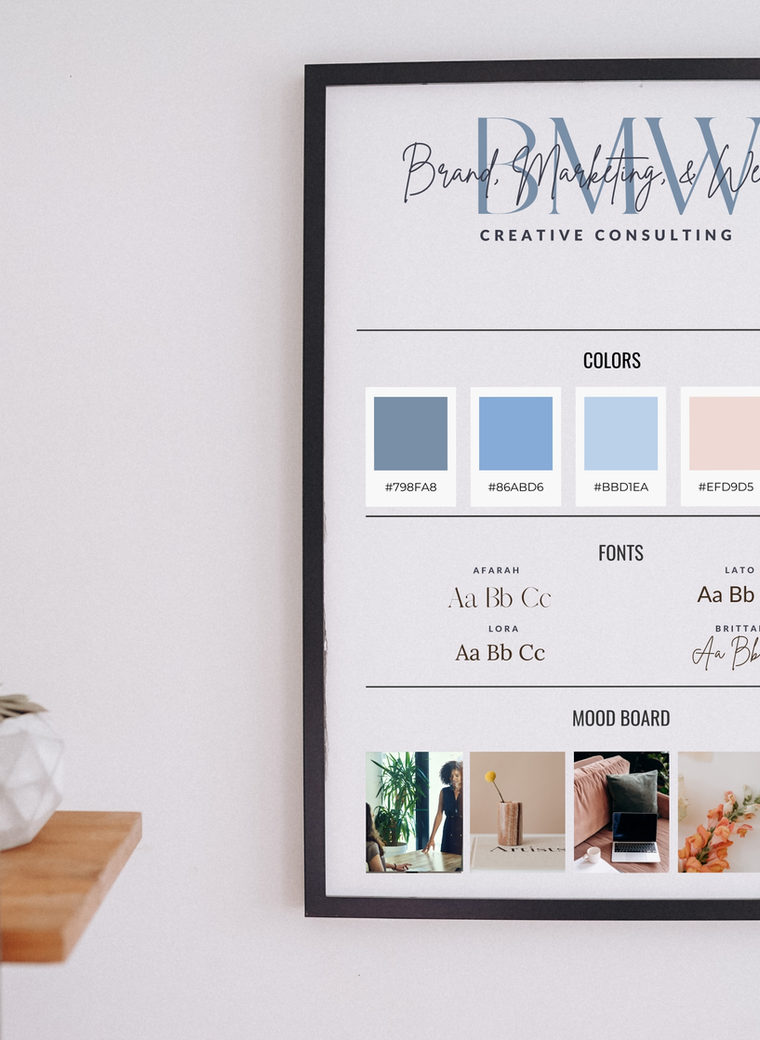
I’ll show you what that does, using my own business. This started as Brooke and Williams Consulting. BMW Creative Consulting still stood for Brooke Mallory Williams. It wasn’t until I sat down with the research behind the work I was doing, and understood what people valued about it, that I clarified my positioning around brand, marketing, and website design. Then it clicked. BMW, Brooke Mallory Williams. BMW, brand, marketing, and website design.
The name didn’t change. What it stood for did, and the research is what told me.
One of the most useful pieces of this is the voice contrast. I’ll pull an actual example of how a competitor talks about something relevant to your brand and put it next to how you’d say it. Seeing the difference on the page is what makes voice concrete rather than abstract.
Your target market, developed into real personas
A demographic and generational overview of who you’re reaching, then developed buyer personas rather than a sentence about your ideal client. This is what the market plan and strategic positioning gets built from.
This is the research that everything downstream depends on. It’s also the research that tends to surprise people.
A light SEO, AEO and GEO audit
I look at what you currently rank for, or should, and whether the search intent behind those terms matches the audience you want. It’s a lighter version of a full SEO audit.
Then I flag what’s fixable now and what’s built wrong underneath. It shapes the keyword and phrase choices in every piece of copy written after it, through brand development and into the website.
Part of this is checking whether anything can find you at all. Some of the questions people used to type into Google now go to an assistant instead, and what comes back names a handful of businesses. If you’re not one of them, nothing tells you. There’s no report for an answer you never showed up in.
So I ask the way your customer would ask, in the words they’d use, and see whether you come up.
You can run this one yourself today, for free. Ask an assistant the question your best customer would ask. Then read what comes back and notice whether you’re in it.
Your existing website and social media
If you already have a site, that helps, because a site records decisions.
The pages that mattered once and now have nothing pointing at them. The spot where the writing changes because somebody else took over for a while. A menu item for a service you stopped offering. Old profiles on platforms you left. A listing with a phone number that isn’t yours anymore.
Somewhere in there is the point where the business got ahead of the way it describes itself. That’s the useful part, because it tells you what the new site has to say that the old one couldn’t.
What this audit tends to prove falls into four outcomes, and I’ve landed on all of them.
That the market is oversaturated and the business hasn’t differentiated itself inside it. That nobody can find the website, along with the reason why. That there’s a disconnect between the brand and the reputation, meaning what the business projects and what people who’ve dealt with it say are two different things. Or that the client has set themselves up for success and the work ahead is amplification rather than repair.
The last one happens more than people expect. Sometimes owners are so far inside the work that they don’t realize what their customers value most about their business. It takes somebody outside of it to see that clearly.
It usually starts one step back
What are your services, how are they priced, how are they explained, and does the way they’re grouped together make sense to somebody who has never heard of you?
What looks like a marketing problem is often sitting in the offer. If your services page confuses people, redesigning it won’t fix that.
Better to find that now than three weeks into a design.
What you walk away with
Here’s what I hear clients say they didn’t realize. The research isn’t internal notes I keep to myself. It goes into the project document we share, and it’s yours.
A competitive analysis. Direct and indirect competitors, broken down by what they offer, how they position, who they target and how they communicate. It exists so you stop guessing at what you’re being measured against. Your buyer is already comparing you to these businesses whether or not you’ve looked at them.
A white space analysis. What nobody in your category is owning. This is what changes decisions, because it’s the difference between saying what everyone says a little better and saying something nobody has claimed.
A competitive voice contrast. How they say it, next to how you say it. Voice stays abstract until you see it on a page beside somebody else’s. Then it’s obvious, and it’s usable.
Target market and buyer personas. Developed, not summarized. The point isn’t a profile. It’s understanding what somebody is weighing, what they’re afraid of getting wrong, and what they need to feel before they’ll spend money with you.
SEO, AEO and GEO audit findings. The keywords, the intent gaps, the quick wins and the structural issues. This tells you whether the words you want to use are the words anybody is searching.
An online audit. What your existing website and social presence are currently doing, and which of the four outcomes above you’re sitting in.
Inspiration research. The brands you named, and what specifically about them resonates. Usually you’re responding to something you haven’t articulated yet. Naming it is what makes it possible to build.
All of it lives in the shared document for the life of the project, and it’s still useful long after the brand is finished. There is business development sitting underneath creative work, and it happens before anybody picks a color.
What the research turns up that isn’t a website problem
Sometimes the research surfaces something the site was never going to solve. Pricing that doesn’t support the business. Capacity that wouldn’t survive the demand more visibility would bring. A bottleneck in how you deliver that would turn a wave of new customers into a wave of unhappy ones.
When one of those comes up, I tell you. That’s part of what you’re getting from this phase, and it’s better found now than after launch.
My job was never to replace what you built. It’s to find where your vision and your execution aren’t matched yet, and build the structure that closes that gap.
If you take one thing from this, take the assistant check. It’s free, and no report currently sends you that answer. Ask the question your best customer would ask and read what comes back.